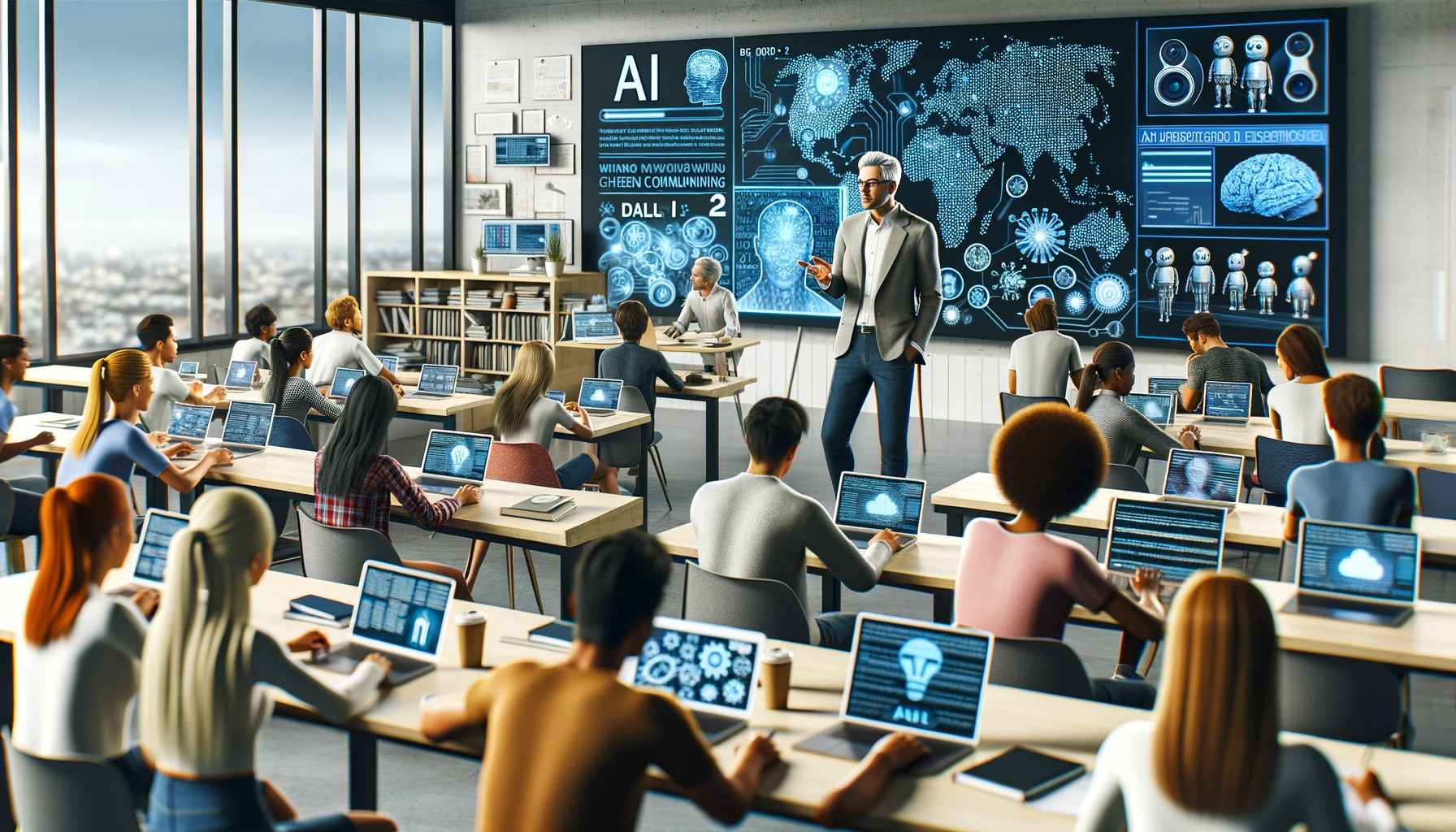
It’s nearly impossible to navigate daily life nowadays without some interaction with AI. From content recommendations on streaming services to GPS, it has become nearly impossible to navigate daily life without interacting with it. AI even helps people find love. It has changed the world quickly, fiercely, and faster than most can keep up.
There is a lot of buzz around what jobs AI might replace. But what about the classroom? Will AI replace teachers? Mixed feelings prevail among parents and educators alike as a new era in education unfolds, with AI inevitably finding its way into classrooms.
Among the trailblazers of a new era, Kimberly Forbes, Fashion Design Instructor, is boldly navigating the integration of AI in education. It’s no small task to reformulate education at the grassroots level, as many educators have now been tasked with doing.
Kim is no stranger to navigating the unknown. When she began teaching at Cascadia Tech Academy in Vancouver, Washington, nine years ago, she developed the school’s technology-based fashion design program, building a curriculum and framework. Now she is developing a student-based enterprise—a student-run business program open to the public.
As a mom of neurodivergent kids, Kim understands the strain of finding individualized focus for diverse learning styles; she has struggled for years to find the right educational fit for her autistic son. As an educator, she wants to give special care to honor each person’s autonomy and nurture their unique potential, just as she does for her own children.
For educators like Kim, this can feel helpless when overwhelmed by the individual needs of 30 students at a time, administrative tasks that pull her away from educating, and the complexities of a growing population of highly neurodivergent people.
Kim sees potential in AI, especially for differentiation—the term she uses for adjusting content or teaching methods for various learning styles.
“To meet the needs of all students, or to meet more specific needs of students, I’ve used AI to take a lesson or concept that I’ve already developed, plug it into an AI bot, and have it readjust a lesson plan or project for a lower-level reading standard. I would say that is definitely a quality that enhances learning.” But this enthusiasm is not unilateral.
She adds, “I tend to embrace technology, but most of my colleagues don’t.”
Regardless of the possibilities, deep concerns about the use of AI in the classroom dwell among many people. What will be the impact of AI on essential human skills, connection, and critical thinking for the next generation? Do the benefits outweigh the risks?
AI technology has great potential to transform education in many ways. Current trends in AI education include enhancing personalized learning and automating administrative tasks. Current methods leave both areas riddled with inefficiencies.
One study shows AI is already integrating with teacher instruction and educational management, carrying an array of ethical implications (Bula and Bonilla). As the education sector transitions into the digital age of AI, concerns abound. The use of AI in the classroom can lead to increased data collection on students and potentially exacerbate existing inequalities. Perhaps none echoes louder than the risk of diminishing human connection.
Nevertheless, there are silver linings. How the education system proceeds in building the foundation of AI integration is critical for the most technology-centered era in human history.
The Evolving History of AI and Learning
Artificial Intelligence (AI) and educational psychology have evolved together, shaping each other. When AI emerged in the mid-twentieth century, early researchers and developers shaped both AI technology and education based on concepts like how the human mind works, what learning is, and how to represent knowledge (Mishra et al.). The way we educate has, in turn, shaped AI technology learning (Mishra et al.). For instance, researchers developed the fundamentals of educational psychology using the concept of human cognition as information processing (Mishra et al.).

AI in the Classroom Today
Today, it might be hard to find an educator who has not been following the progression of AI. However, when it comes to using AI in the classroom, there is often little to no guidance. Teachers like Kim are tackling the emergence of AI in the classroom head-on, while others seem to be less keen.
Kim notes, “There’s a lot of fear around it (AI in education), and I think we’re all navigating it in a way we can.”
She emphasizes the importance of engagement: “It’s always good to be at the forefront of technology and understanding its impacts. Being educated about the possibilities, instead of sticking your head in the sand and pretending it’s not there. In a school of say, thirty instructors, there might be a handful of us that are actually using it.”
Another trailblazer is one of Kim’s colleagues, Chef R. Andrew McColley CEC, CCE. Chef McColley is the Culinary, Baking, and Pastry Arts instructor at Cascadia Tech Academy in Vancouver, Washington. Andrew is an academically and professionally trained chef who holds additional certifications in education and school administration with a focus on Career and Technical Education.
Andrew has been following the development of AI both broadly and within the classroom, observing significant benefits and potential challenges or negative impacts. In his own classroom, Chef Andrew is already using AI to generate puzzles, design problem-solving scenarios, and create images that contain hidden sanitation errors for students to identify and correct.
Kim finds similar ways to use AI, including overcoming language barriers through AI translation technology. She feels it’s giving them access to something they wouldn’t usually have, especially when their education is not delivered in their first language. She has seen it work well with her English language learners.

AI for Personalized Education
The Statistics Speak
Personalized learning is a current trend in AI education. This approach addresses a student’s unique needs by customizing learning experiences based on individual pace, interests, and style—a vital shift from traditional methods that often fail to accommodate diverse learners (Oyebola Olusola Ayeni et al.).
Chef Andrew strongly believes integrating AI will significantly improve educators’ ability to meet these diverse learning needs. He points out:
“Only about 30–33% of students achieve proficiency in reading, writing, and mathematics. When we compare this to the three most basic learning modalities—visual, auditory, and kinesthetic, the current educational model aligns almost entirely with auditory instruction. This means the system effectively supports only approximately one-third of students who learn best through listening, while the remaining 67% receive instruction in a modality that does not match how they learn.
AI for the Spectrum of Learners
Bringing hope to shocking statistics, Chef Andrew continues,
“AI has the potential to transform this dynamic by enabling educators to create individualized, multimodal learning experiences rather than relying on a single mode of instruction. With AI-driven tools, we can develop visual supports, interactive activities, simulations, demonstrations, and personalized practice that address the full spectrum of learning preferences. As a result, overall achievement has the potential to rise because instruction becomes tailored to the individual learner rather than the mass classroom model.
“In many ways, this reflects the core philosophy of an IEP -Individualized Education Planning – applied universally. AI allows us to move closer to a system where every student receives instruction in the modality that best enables their success.”
Riley, whose name has been changed to protect their job under district guidelines, is another pioneer in education and technology, spearheading their district’s STEAM (Science, Technology, Engineering, Art, Mathematics) program.
Riley, an educator for 26 years, explains, “It’s a way to meet students where they are. When I’m teaching a class of thirty, I have students who are second-grade readers, and students who are seventh-grade readers, and I’m trying to hit it somewhere in the middle. But, I’m underchallenging the ones at the top and overchallenging the ones at the bottom.”
He adds, “AI can be there for that person at the point when they need it and give them faster feedback than the teacher can.”
AI for Administrative Tasks
Research shows teachers spend up to 50% of their time on administrative tasks. Tasks such as grading and assessment, evaluation, personalized responses to parents and students, attendance, student enrollment, course management, data management, and budgeting (Ahmad et al.).
When asked how much time Kim Forbes spends on administrative tasks, she laughed and asked, “Paid or unpaid?” A very revealing rhetorical question. She confirms she spends about fifty hours a week on non-educational tasks.
Kim feels that part of the challenge of using AI for administrative tasks is learning how to use it to perform the task. And for teachers who have been doing something a certain way for so long, the uphill battle is learning to do the task with AI rather than just doing it the way they already know how. She imagines it would be as harmless and helpful as having an assistant.
Teachers feel that if the integration of tasks had a low enough learning curve not to cause them more time and effort than they already spend on administrative tasks, they might gladly embrace it.
Andrew feels that AI-generated communications can sound generic and automated. This can undermine trust. Families may feel frustrated or dismissed when they receive impersonal, semi-automated messages about a student they care deeply about.

The Ethical Implications of AI
The transition to AI education carries significant baggage. Chief among the concerns are issues surrounding student information, leading to complex questions about privacy and security.
Data Privacy and Security
For all AI systems potentially implemented in schools, vast amounts of student data are required. Not only does the data need to be secure and private, but how much data should be ethically allowed to be collected on an individual before they are old enough to understand the implications and risks?
Some systems are in place, like at Cascadia Tech, where parents must sign a permission form for students to use sites where their data may be collected.
Teachers agree that protecting the student’s privacy and identity is of the utmost importance. Riley knows data collection is required, especially if individual learning is implemented using AI: the key, however, is using an identifier that does not personally identify the student. They feel an even bigger issue is where the information should go after the student moves on. And that it should not go to employers or other entities because it should not limit a person’s ability based on AI interpretation.
Bias
In addition to data privacy and security, there is the risk of algorithmic biases and digital technology inequity. AI algorithms are trained on historical data, which, if biased, can perpetuate and amplify these biases related to gender, ethnicity, or socioeconomic status (Oyebola Olusola Ayeni et al.). As well, not all students have equal access to the technology needed for AI systems in schools, creating disparity in education opportunities (Oyebola Olusola Ayeni et al.).
Kim has already noticed bias in AI translations for students. Some students have encountered translations that imply slurs or convey inappropriate meanings.
While correcting algorithmic bias is a technical hurdle, perhaps the greatest fear among educators is the risk to the classroom environment itself.
Diminishing Human Connection
Although AI can assist teachers and students alike, it can never replace the essential human connection. Teachers provide leadership, intuitive guidance, and mentorship to students at every level of human development. The bond between humans is critical.
Andrew feels excessive reliance on AI to create instructional material can erode the personal touch essential to effective teaching, stating: “We often talk about the ‘three R’s’ of education as reading, writing, and arithmetic, but the real three Rs are relationship, relevance, and vigor.”
He reiterates that students need to know how much a teacher cares before they care how much a teacher knows. Once a strong relationship is built, and students understand the relevance of what they are learning, then authentic rigor can be introduced to help them reach deeper levels of understanding—a part of education where human interaction and judgement cannot be understated.

Charting a Course for the Future
The Logistics of Implementation
Implementing AI in the classroom is not so cut-and-dry either. For educators like Kim and Andrew working in what would be considered a fairly large school district, some help and guidance have already arrived.
According to Kim, their district offers additional upgrades to ChatGPT for educator use, various types of AI training and support, and AI certifications through an outside provider, paid for by the school for teachers and students.
Other districts may lack the resources to implement an AI strategy of the same magnitude. Without the district’s backing, teachers may hesitate to navigate new waters for financial and ethical reasons.
Riley attempted to try a new AI-based program a couple of years ago. They were not successful.
“I couldn’t get access. The school didn’t qualify for the program, and I wasn’t going to pay for it because it was very expensive. “For the teacher, if you’re going to get teachers interested, it has to be free or it has to be approved by admin because they’re the ones who hold the purse strings to buy it. That’s what it really comes down to.”
AI: A Tool, Not a Crutch
All three educators took a similar stance on how teachers and students should approach AI in education. All agree it should be used as a tool, not a replacement for critical thinking, by both educators and students.
Kim sees potential for teachers getting lazier or falling under false pretenses that it’s going to improve their classroom management abilities, stating, “If they have bad classroom management, they have bad classroom management. And that’s a lot of what teaching is, managing the cats.”
Chef Andrew warns:
“AI can easily become a crutch, something educators lean on too heavily rather than using it intentionally and thoughtfully.
“When this happens, AI stops enhancing instructional practice and starts replacing the very skills, judgment, and personal connection that define effective teaching.
“The challenge is not the technology itself, but how we choose to integrate it: as a tool that strengthens our practice, or as a shortcut that slowly erodes it.”
The Risk of a Quick Fix
Riley is concerned that students will use AI to circumvent their learning and not use it as a learning tool, producing work without thought and without an understanding of how and why something is put together.
Riley states, “If you want something, then you learn how to do it.
“The students will (use AI) right off the bat. It’s the teachers who are being very cautious. The students are going to try because they’re all about being quick.
“I’m seeing that this generation is ‘I want to be done, and do something else.’ Which could be good, but not spending the time to focus and understand, and not just saying ‘Oh, the answer is five’ and moving on. Why is it five?
“That piece still needs to be there, and I feel like it’s fleeting. They’re not sticking around or have the perseverance to stick around and go back through and get that kind of piece of it. That’s the concern that the understanding of how it’s doing it, why it’s doing it, and having those components together.”
Time for Change and Innovation
Educators agree that guidelines must be made. Some feel strict laws mimicking HIPAA should be in place locally and nationally.
Andrew warns of overly rigid or highly specific rules that limit creativity and remove some of the innovative, exploratory spirit that makes using AI both engaging and effective.
Riley would like to see the education system adapt a little more and try to meet kids where they are now. He feels students are so diverse now, and they bring so many layers and challenges that the old days of blue-collar schools no longer exist. And to keep putting students into that old way isn’t going to keep working. The platform should change.
Perhaps AI will be the catalyst for precisely that, a dramatic change to the old way.
Andrew McColley provides an eloquent guide for proceeding into this uncharted new era:
“In my program, we operate a fully functional restaurant, and we constantly emphasize the importance of using tools correctly.
“A pot can be used as a hammer, but that’s not what it was designed for. And a knife is essential in the kitchen, but only when students learn to use it properly, so that they start with ten fingers and finish with ten fingers. The same principle applies to AI.”
Kim Forbes offers some final food for thought, assuring there will always be a need for teachers, “AI can write a decent sentence, but it cannot replace the deferment to know whether the information is accurate. We still need teachers to show students how to use it responsibly and accurately.”
Works Cited
Ahmad, Sayed Fayaz, et al. “Academic and Administrative Role of Artificial Intelligence in Education.” Sustainability, vol. 14, no. 3, Jan. 2022, p. 1101, https://doi.org/10.3390/su14031101. Web of Science.
Bula, Robin Bustamante, and Aureliano Camacho Bonilla. “Artificial Intelligence (AI) in Schools: A Systematic Review (2019-2023).” Enunciación, vol. 29, no. 1, District University of Bogotá, Aug. 2024, pp. 62–82, https://doi.org/10.14483/22486798.22039.
Mishra, Punya, et al. “Control vs. Agency: Exploring the History of AI in Education.” TechTrends, vol. 69, no. 2, Springer Science+Business Media, Mar. 2025, pp. 247–53, https://doi.org/10.1007/s11528-025-01064-2. Web of Science.
Oyebola Olusola Ayeni, et al. “AI in Education: A Review of Personalized Learning and Educational Technology.” GSC Advanced Research and Reviews, vol. 18, no. 2, GSC Online Press, Feb. 2024, pp. 261–71, https://doi.org/10.30574/gscarr.2024.18.2.0062.
Headline Image Credit
Image from Flickr. Created by Wes Fryer. Creative Commons License: CC BY





Leave a Reply