DEFINITION FOR HIGH-CONTEXT AUDIENCE
The Narrative Arc (also called the Story Arc) is a five-part, chronological structure for a story. The five chronological parts include: the exposition where characters, setting, and situations are introduced; the nouement (French word for knotting), or “knotting up” period, a rise in action through complications and conflicts; a climax of events, crisis, or moment of highest tension; an anticlimax or fall in action as conflicts begin to resolve; a denouement (French word for the untying), or “unknotting”, with a conclusion of resolutions to the characters and conflicts (Burroway, Stuckey-French, & Stuckey-French, 2019, p. 134). The narrative arc was developed by the nineteenth-century German critic Gustav Freytag to analyze a story’s plot in terms of a pyramid of five actions (Burroway, Stuckey-French, & Stuckey-French, 2019, p. 134). Today, the arc resembles an inverted checkmark (Burroway, Stuckey-French, & Stuckey-French, 2019, p. 134). The introduction, or situation, is a phase of instability where the storyteller details relationships, compulsions, oppositions, and initial conflict (George, 2004, p. 212). As the plot intensifies during the rise in action through complication, there is a deepening of opposition and an intensification of tension (George, 2004, p. 212). The stage of climax comes through a crisis, where there is a revelation or recognition (George, 2004, p. 212). The fall in action and tension is the anticlimax, or unknotting of conflicts phase. (George, 2004, p. 212). The final phase is the resolution, where change and stability are achieved (George, 2004, p. 212).
HIGHLIGHTS:
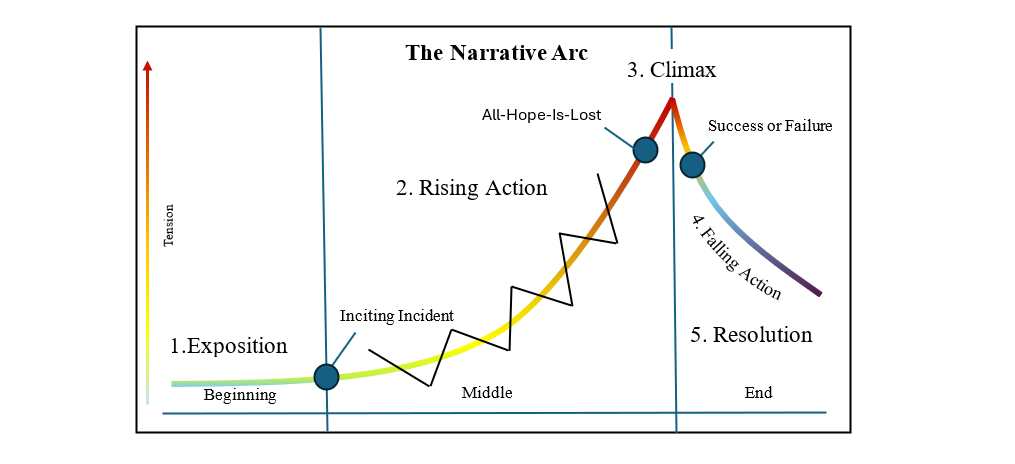
During the Exposition, step one in Figure 2, initial tension is created through the introduction of characters, their relationships, compulsions, and oppositions. Elizabeth George describes this phase as a time of establishment, where the characters’ conflicts come to light, placing them in opposition and creating a situation of instability (George, 2004, p. 213). The Inciting Event, the following point as seen in Figure 2, is described by Larry Brooks as something huge, dramatic, and game-changing; a one-way door the hero passes through to the future, and this event usually induces the first plot point, the moment that alters a hero’s status, plans, and beliefs, forcing them to take action in response (Brooks, 2013, p. 164). During the nouement, step two in Figure 2, or knotting up, action rises, so do tensions and conflicts among characters as their wants, needs, and intentions meet resistance (George, 2004, p. 213). This period may show ups and downs in tension as the characters achieve small victories, only to face more conflict, as seen by the zigzag on the rising arc in Figure 2. Step 3 in Figure 2 —the climax, after “All-Hope-Is-Lost” — is a final piece of narrative information that gives the hero everything they need to become the primary catalyst in the story’s conclusion (Brooks, 2013, p. 166). The hero may experience success or failure, as shown in the next point in Figure 2. This serves as a benchmark for determining the hero’s outcome. As tension decreases in the denouement (step four in Figure 2, or unknotting), characters experience a reappraisal of “life as we know it” (George, 2004, p. 213). The hero summons courage to find a solution or overcome the antagonism to achieve their goal (Brooks, 2013, p. 167). The resolution, step five in Figure 2, follows as the story comes to an end. Elizabeth George concludes that the situation has changed now for the characters due to the events that have occurred in the story (George, 2004, p. 213).
EXAMPLE:
An example that can help examine the individual components of the narrative arc is the age-old story of Beauty and the Beast. The story begins with exposition: the setting is described, and the main characters are introduced —Beauty and her father. Initial tension is created with Beauty’s desire for something more than her small life and an overbearing man who pursues her. Beauty must decide to save her father and live with the newly introduced Beast, who appears cruel and dangerous. This is the inciting incident that alters her plans, compelling her to act.
During the rising action, Beauty and the Beast experience rising tension as they dislike each other, but eventually grow to care for each other. These tensions rise and fall when the Beast shows tenderness, then explosive anger, repeating the pattern multiple times. Beauty and the Beast have a falling-out, leaving both feeling as if all hope is lost. At the climax, the earlier overbearing character pursuing Beauty appears, and the Beast nearly dies in an action scene. Beauty must make a big decision about whether she has genuine love for the Beast. Success or failure is determined when the final petal falls off a magical rose. Her love for the beast came to fruition just in time to achieve success. During the falling action, the Beast awakens from near death and realizes they love each other. The Beast undergoes a physical transformation, and Beauty undergoes an inward transformation. The conclusion sees them living happily ever after.

Figure 2: The Narrative Arc (also called the Story Arc) is a five-part, chronological structure for a story. The five chronological parts include: the exposition; the nouement, or “knotting up”; a climax of events, crisis, or moment of highest tension; a denouement, or “unknotting”, which is the fall in action; and a conclusion (Burroway, Stuckey-French, & Stuckey-French, 2019, p. 134). Notable features of the arc are the point of an Inciting Incident, a zigzag of event ups and downs in tension, a point of All-Hope-Is-lost, and a point of Success or Failure (Brooks, 2013, pp. 164-166) (Burroway, Stuckey-French, & Stuckey-French, 2019, p. 135).
During the Exposition, step one, initial tension is created through the introduction of characters, their relationships, compulsions, and oppositions. The Inciting Event, the next point, is something huge, dramatic, and game-changing (Brooks, 2013, p. 164). During the nouement, step two, or knotting up, action rises, so do tensions and conflicts among characters as their wants, needs, and intentions meet resistance. (George, 2004, p. 213). This period may show ups and downs in tension as seen by the zigzag on the rising arc. The climax, step 3, after “All-Hope-Is-Lost,” is a final piece of narrative information giving the hero everything they need to become the primary catalyst in the story’s conclusion (Brooks, 2013, p. 166). The hero may experience success or failure, the next point. This is a benchmark for determining the hero’s outcome. As tension decreases in the denouement, step four, or unknotting, characters experience a reappraisal of “life as we know it” (George, 2004, p. 213). The resolution follows at step five as the story comes to an end.
ALT TEXT:
A diagram of the Narrative Arc with numbered stages: (1) Beginning Exposition, (2) Middle Rising Action, (3) Climax at the top of the arc, (4) a slope down with Falling Action, and lastly, (5) the arc finishing with Resolution. Additional labels on the arc include the Inciting Incident, a zigzag of event ups and downs in tension, the point of All-Hope-Is-Lost, and the point of Success or Failure. The slope of the arc is marked with a color gradient that indicates increasing tension, mimicking the color gradient of an arrow pointing up, labeled “Tension.” The arc starts with green at the Introduction, moves upward through yellow and orange, reaches red at the peak climax, then slopes downward through orange, yellow, green, and blue, finishing with purple at the Resolution.
References
Burroway, J., Stuckey-French, E., & Stuckey-French, N. (2019). “The Tower and the Net” in Writing Fiction. Chicago: The University of Chicago Press.
George, E. (2004). “Gimme a Map, Please” in Write Away. New York: HarperCollins Publishers Inc.
Brooks, L. (2013). “The Six Core Competencies of Successful Storytelling: A 101 Review” in Story Physics. Blue Ash: Writer’s Digest Books.






Leave a Reply